Two years after buying Fresh Burritos, UK chain Tortilla has closed five loss-making restaurants in France, aligned the menu with its British recipes and made the French team report to the London support office. Like-for-like sales at converted sites are up more than 20%. The division is still loss-making.
In 2024, the British Mexican fast-casual chain Tortilla Mexican Grill bought Fresh Burritos for £3.3m. The deal brought it thirteen owned restaurants in France. Integration went badly. A review of the French subsidiary later found that £2.7m of revenue and operating costs had been recorded on the balance sheet rather than the income statement in the 2025 financial year. The group retrospectively breached its banking covenants; Santander waived the breaches.
Brandon Stephens, the brand’s founder, returned as chief executive in February 2026. His first decisions in France were less about the product than about the number of things the business does.
A site-by-site diagnosis
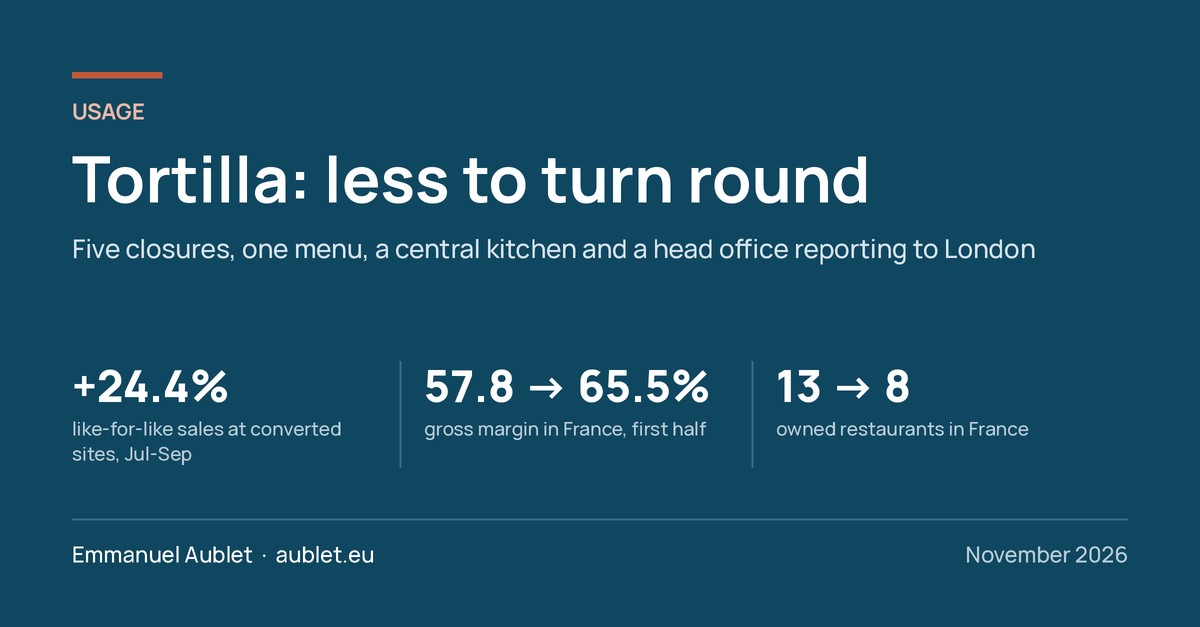
The French estate was split into two groups: sites already trading as Tortilla, and unconverted Fresh Burritos. Five of the latter were closed, three in the first half and two since. Over the twelve months to June they had lost £1.1m. The owned estate fell from thirteen to eight restaurants: seven Tortilla sites and one Fresh Burritos whose future has not been settled. The estate is now clustered largely in Paris “for operational viability”. Closures cost £0.6m in exceptional charges.
The founder himself describes a “fairly ruthless” closure programme. The logic is that of any emergency phase: stop the cash losses first, then concentrate investment on sites with proven unit economics.
One menu, one set of recipes, one central kitchen
The French menu is now aligned with all UK recipes. The 1,400 sq m central production kitchen in Lille makes almost all toppings. In restaurants, only guacamole, salsa verde and pico de gallo are prepared on site. Everything else is regenerated using procedures that, according to the group, avoid the need for skilled chefs, extraction or large kitchens.
For customers, a fourth menu screen has been installed in every French restaurant to guide ordering step by step. Marketing has become educational: explaining what a burrito is and stepping up sampling. A pricing reset accompanied the conversions. In January 2026, the group said its first six converted restaurants were averaging 39% more transactions and 30% more sales than before.
The effect shows up in margins. Gross margin in France rose from 57.8% in the first half of 2025 to 65.5% in the first half of 2026, reaching 70% in converted restaurants by the end of the period.
A smaller head office, common systems
The French head office has been resized: its people costs have been halved on an annualised basis, saving about £0.4m a year. French departments now report directly to the UK support office, and the legal structure has been simplified. Accounting is moving to the same Sage platform as in the UK, and tills to the same Oracle EPOS system, with roll-out due in the fourth quarter. A French operations director, formerly with Pret A Manger in the UK, has been hired.
Delivery has been opened to both Uber Eats and Deliveroo, and delivery sales have doubled. In the thirteen weeks to 27 September, like-for-like sales at the seven converted restaurants rose 24.4%: up 19.5% in store and 88.4% on delivery. In the first half, the increase was 18.2%.
What it changes for operations
Tortilla’s French turnaround follows a classic sequence: site-by-site diagnosis, rapid closures, a simpler offer, then measurement. What makes it worth watching is what it removes from operations: one menu, toppings made in a central kitchen, one till and accounting system, one reporting line. The 2025 accounting error shows the cost of separate reporting.
The limits remain significant. The French division still posted an adjusted EBITDA loss of £2.1m in the first half, against £2.8m a year earlier. The group gives no date for breaking even. Among its downside scenarios, it even cites a full exit from France through liquidation. Sales growth covers seven restaurants and owes much to delivery, a channel whose profitability depends on platform commissions.
Three conditions look decisive. Decide quickly on the sites that will not make it, with a P&L for every restaurant. Reduce what the restaurant team must know how to do, so that quality does not depend on a chef. Plug the subsidiary into the parent’s tools from day one, not two years later.
Sources
- Tortilla Mexican Grill, H1 FY26 interim results, 29 September 2026.
- Tortilla Mexican Grill, H1 FY26 and FY25 results presentation, September 2026.
- Tortilla Mexican Grill, trading statement, 28 January 2026.
- Tortilla Mexican Grill, interim results earnings call, Investing.com transcript, October 2026.
- The Caterer, “Tortilla UK division outperforms competition despite ’challenging’ market”, 27 July 2026.
- Reading grid: Aaron Allen & Associates, “Restaurant Turnaround” (no figures used).