Carrefour Proximité is launching Gus & Mia, a takeaway fast-food brand with no table service. The first outlet is due to open in Toulouse by the end of November, with a menu of around forty items and operations entrusted to restaurateurs under management leases. The retailer is giving itself time to test before opening about thirty in 2027.
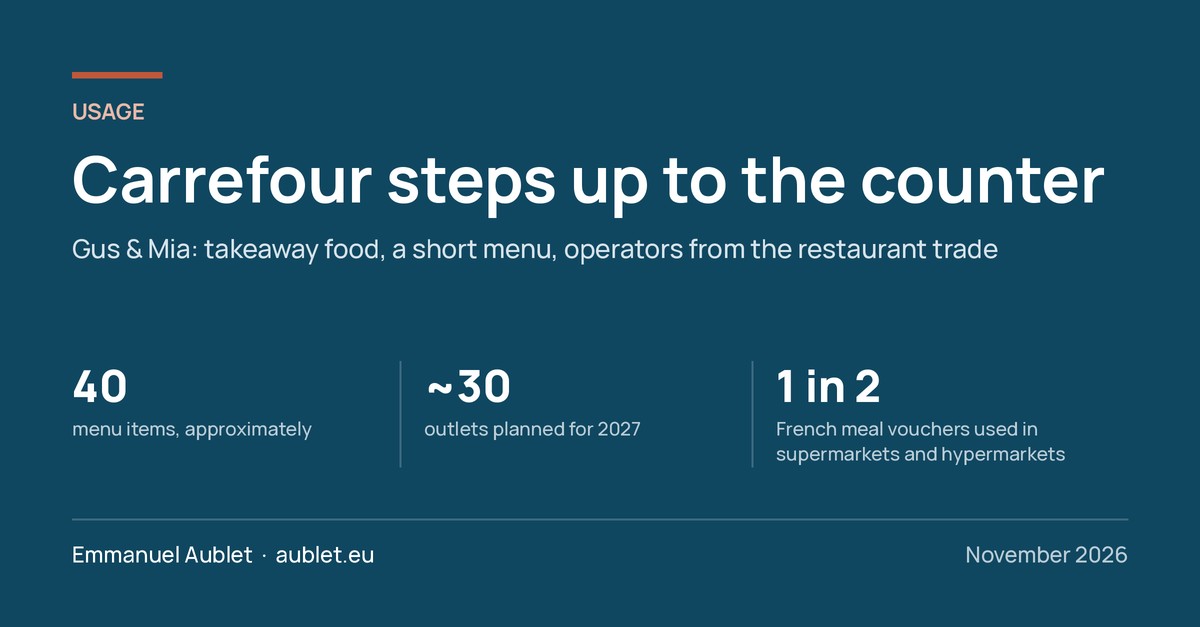
Benoît Soury, chairman of Carrefour Proximité France, unveiled the new brand on 18 November at the Forum de la proximité organised by LSA. “In convenience, we can take risks,” he said. Two Gus & Mia establishments have been on the French business register since 16 November, on rue Gambetta and rue d’Alsace-Lorraine in central Toulouse. Five more outlets are to follow, notably in Paris. About thirty are planned for 2027, depending on results.
The project does not carry the Carrefour name. The group is not adding a deli counter to its neighbourhood stores: it is opening restaurants, registered as such, and targeting the customers of fast-food chains.
Lunch is shifting towards retail
The move reflects first a change in habits. According to Gira Conseil, food channels other than restaurants accounted for €25bn in 2025, about 20% of French out-of-home food consumption. According to NielsenIQ, one meal voucher in two is used in supermarkets and hypermarkets in 2026.
Budgets remain tight. An Ifop survey for Edenred of 2,500 working people, conducted in March, puts average lunch spending at €8.30, with a median of €6. On this slot, convenience retail has an asset: density. Carrefour Proximité operates 4,890 stores and claims a 43% share of the convenience channel.
The Casino group’s two convenience chains have taken other routes. Franprix has made takeaway food “a strong development axis”, according to its chief executive, François Alarcon: it accounted for 10% to 15% of its stores’ sales in 2025. Its Oxygène concept, targeted at 800 stores by 2030, puts snacking at the store entrance, with partners such as My Pie and Kumo. At Place Victor-Hugo in Paris, takeaway food now represents 20% of the store’s business, twice its pre-refit share. The group, which is due to be renamed Plesio, aims for half of its retail sales to be linked to takeaway food within ten years.
Monoprix comes closer to Carrefour. Its La Cantine space, launched in April 2025, is an identified food-service concept, also sold on Uber Eats and Deliveroo, but located inside the store. At Beaugrenelle in Paris, it covers 70 sq m, with three self-checkouts and a target wait of under five minutes. Present in 22 stores at the end of September, it is due to exceed 50 sites by 2030; the chain credits it with an average sales uplift of about 10% in the stores concerned. The chain has also run monop’daily since 2007, a cross between a neighbourhood shop and a takeaway fast-food outlet: the closest precedent to Gus & Mia. Like Carrefour, Monoprix is handing over operations: 365 of its 620 stores are run by franchisees or management-lease operators.
Franprix puts food service inside the store, Monoprix gives it a brand, and Carrefour also gives it its own premises.
A short menu, know-how borrowed from Match
The concept draws on two models. The first is internal: Match, the supermarket chain acquired with Cora in summer 2024, is known for its prepared dishes. Carrefour intends to reuse its expertise in fresh food and on-site preparation. The second is external: Ikea’s in-store restaurants, which Benoît Soury cites as the example to follow.
The format keeps few variables: around forty items, takeaway only, no table service. For an operator, the labour equation is simpler than in a conventional restaurant: fewer positions, and a flow built around the counter and the till.
Operations are handed to management-lease operators “from the restaurant world”. Carrefour keeps ownership of the business and leases out its operation. The model is familiar in French convenience retail, where management leases are widespread. It lets the retailer test a trade it does not master by relying on professionals, without recruiting the teams for each site itself.
Lessons from the Match Frais trial
The group already has a recent precedent. Since July, Match has been testing a fresh-food concept, Match Frais, at Faches-Thumesnil near Lille, and since 4 November at Thillois near Reims. The deli counter accounted for 20% of the first store’s sales. But first-year sales fell short of the €10m target, and overall traffic was “more complicated” than expected, according to LSA.
Two lessons apply directly to Gus & Mia. First, being unable to accept meal vouchers for two and a half months after opening was described as a major handicap. Second, in the smaller Reims store, the offer was narrowed: the same breadth, less depth, and fewer prepared dishes delivered from Match’s Lille kitchen. Managers also acknowledge a lack of city-centre experience.
What it changes for operations
The boundary between grocery retail and fast food is moving to the counter. The retailer brings density, purchasing and production know-how. The restaurateur brings execution. A short menu and no table service reduce the number of tasks in each outlet. By comparison, La Cantine at Beaugrenelle, where almost everything is prepared on site, employs about fifteen people for 70 sq m.
The limits are many at this stage. Carrefour has published no prices, no target average ticket and no unit economics. The first outlet has not yet opened.
Three conditions look decisive. Accept meal vouchers from day one. Set a clear split between what is produced upstream and what is prepared on site, so that quality does not depend on the location. Give each operator a few simple indicators, reviewed weekly, before moving from six outlets to thirty. The Subway case shows this kind of scale-up with independent operators.
Sources
- LSA, “Carrefour Proximité va lancer deux nouvelles enseignes dans la restauration et le travel retail”, 18 November 2026.
- L’Express Franchise, “Carrefour lance Gus & Mia à Toulouse et Étape Express dans 45 gares du Grand Paris Express”, 19 November 2026.
- RMC Conso, “Inspiré de ce qu’a fait IKEA”: à quoi va ressembler le nouveau concept de restauration rapide de Carrefour ?, 20 November 2026.
- LSA, “Carrefour : premières leçons et premiers ajustements pour le concept Match Frais à Reims”, 3 November 2026.
- Snacking.fr, “Bernard Boutboul : les restaurants ne sont plus les seuls à nourrir les Français hors domicile”, 21 October 2026.
- L’Express Franchise, “Avec son concept très performant, Franprix vise de nouvelles ouvertures”, 2 March 2026.
- EcommerceMag, “Franprix : le concept Oxygène franchit le cap des 100 magasins”, 18 February 2026.
- Snacking.fr, “Pourquoi le commerce de proximité doit désormais penser comme un restaurateur, selon Philippe Palazzi”, 8 June 2026.
- Le Figaro, “Le groupe Casino (Monoprix, Franprix…) change de nom et devient Plesio”, 20 October 2026.
- Le Figaro, “Nouveau design, espaces de restauration… Monoprix se lance dans la rénovation de tous ses magasins”, 7 July 2026.
- L’Express Franchise, “Monoprix confie près de 6 magasins sur 10 à ses franchisés”, 12 November 2026.
- Monoprix, “Nos enseignes”, accessed 23 November 2026.
- Républik Retail, “Les 5 partis pris du nouveau concept de restauration de Monoprix”, 3 April 2025.
- NielsenIQ, “Gagner la bataille du midi”, 17 November 2026.
- Edenred, “Edenred et l’Ifop publient la première grande enquête sur la pause déjeuner des Français”, July 2026.